Meaningful educational reform begins with intentional leadership. HopeMore International partners with schools and educational organizations to strengthen leadership, improve organizational systems, and create the conditions where educators and students are encouraged to thrive.
At HopeMore International, we believe lasting educational improvement begins by intentionally creating conditions that encourage people to thrive.
HopeMore International – Educational Leadership Consultants for K–12 Reform | Mission
HopeMore International Educational Leadership Consultants exists to create a better tomorrow for future generations by partnering with K–12 schools to strengthen leadership, improve instructional systems, and intentionally create the conditions where educators and students thrive. Through research-informed consulting, leadership coaching, professional development, organizational development, and data-informed decision making, we help schools build leadership capacity, strengthen school culture, and achieve sustainable improvement.
HopeMore International – Educational Leadership Consultants for K–12 Reform | Vision
We envision K–12 schools where intentional leaders create the conditions for every student, educator, and school community to thrive academically, socially, and emotionally. HopeMore International Educational Leadership Consultants aspires to be a trusted partner in strengthening leadership, improving instructional excellence, and building resilient educational systems that respond thoughtfully to changing student needs. By developing leaders, strengthening organizations, and fostering cultures of continuous improvement, we help create a better tomorrow for future generations.
HopeMore International Educational Leadership’s Philosophy
Where Are They Now?
The effects of the COVID-19 pandemic did not end when students returned to school.
Each student experienced the pandemic differently based on family circumstances, instructional support, technology access, and learning opportunities.
As those students continue progressing through elementary school, secondary education, college, and the workforce, educational leaders have an opportunity—and a responsibility—to better understand these long-term effects.
HopeMore International encourages organizations to examine student success from a longitudinal perspective while focusing on understanding, support, and intentional institutional improvement rather than blame.
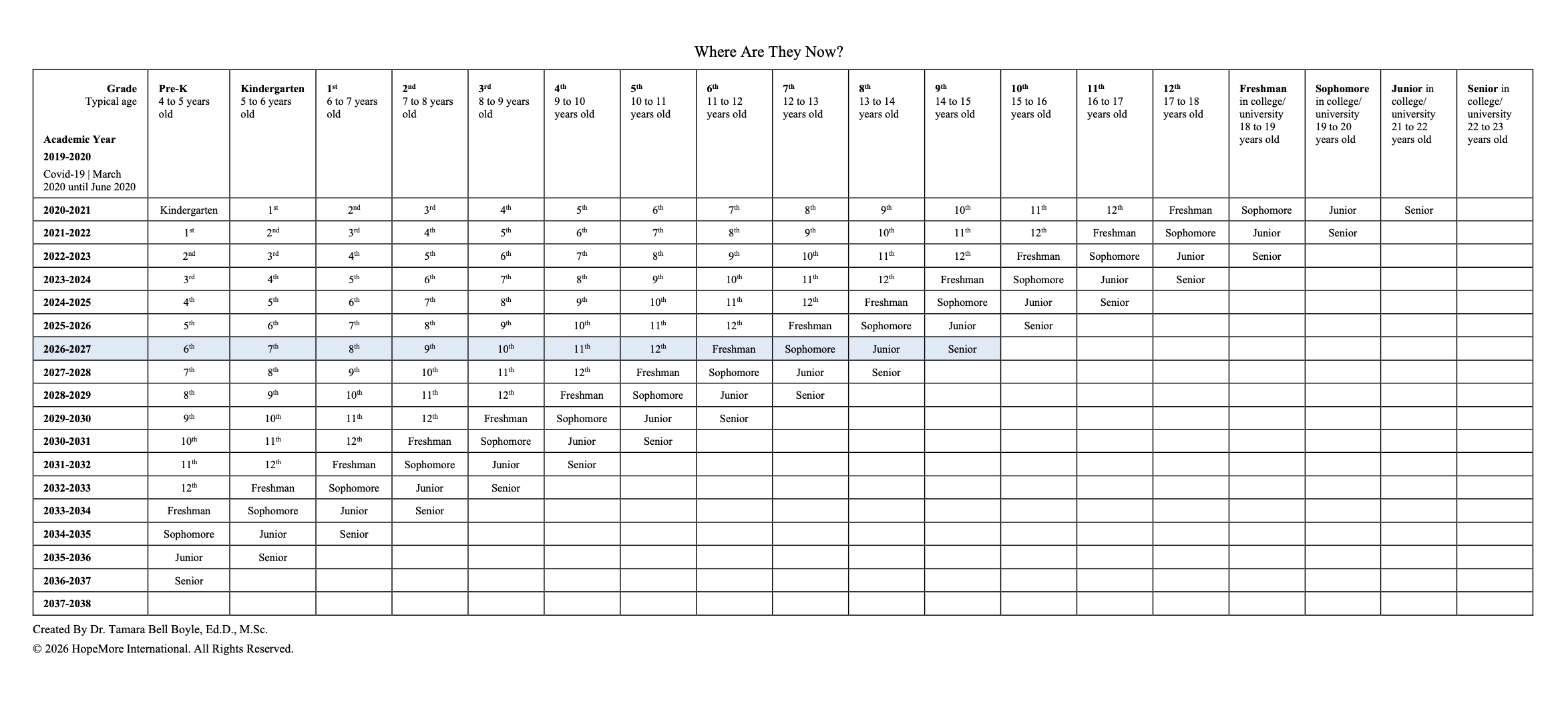
HopeMore International wholeheartedly believes all educators should consider what grade their students were in during the Covid-19 pandemic lock-down, because their student(s) could be missing information from that time period (i.e., Covid-19 learning gap).
The chart above illustrates where they (i.e., the students) are now and where the students were during the Covid-19 pandemic lock-down. Using the blue highlighted row, for the academic school year of 2026-2027, locate the student’s current grade. Then the top of that column will show what grade the student(s) was in during the Covid-19 pandemic lock-down (i.e., March 2020 until June 2020). In addition, one should also consider the academic school year of 2020-2021 because some schools allowed their students to attend school in-person one day a week and four days remote; then a few months later allowed their students to attend school in-person two days and three days remote. Furthermore, some parents chose to keep their children home and had them attend school remotely all five days. Lastly, some schools required students who were exposed or came into close contact with a person who tested positive for Covid-19 to remain at home and learn remote up to two weeks. Therefore, educators should also consider the next grade, which is directly to the right of what grade the student(s) were in during Covid-19.
For example, a current 11th grader was in 4th grade during the Covid-19 pandemic lock-down (i.e., March 2020 until June 2020) and then 5th grade for when most educational institutions started the year with one day a week in-person and 4 days of the week remote, followed by a two days of the week in-person and three days of the week remote (i.e., academic school year of 2020-2021).
According to the chart above, students who were in Pre-K, 4 to 5 years old, during the Covid-19 pandemic lock-down (i.e., March 2020 until June 2020), will be high school seniors in the academic school year of 2032-2033 and higher education seniors in the academic school year of 2036-2037.
However, adjustments are needed for those students that repeated a grade.
Please note, if you are viewing on your mobile device you may need to rotate your device to be in landscape mode for the full view of Where Are They Now? Chart.
Educational Leadership Consultants Services
HopeMore International Educational Leadership Consultants focuses on nine core areas that work synergistically to transform school communities:
School Safety & Organizational Preparedness
Leadership Development
Organizational Development
Strategic Vision and Planning
School Improvement
Student Success
Instruction and Curriculum
Culture Change
Data-Driven Decision Making
Explore our consulting services designed to strengthen leadership, improve systems, and intentionally create conditions that encourage people to thrive.
Additional services are available as needed. Let us know your ideas.
-
How do educational leaders intentionally create school communities that are prepared before something goes wrong?
HopeMore International Educational Leadership Consultants helps educational leaders examine school safety procedures, emergency preparedness, communication systems, roles and responsibilities, and organizational readiness. Through research-informed analysis and practical planning, we help school communities identify gaps, strengthen procedures, clarify responsibilities, and develop strategies that support preparedness, effective emergency response, and organizational resilience. This work is informed by HopeMore's broader approach to school safety and organizational preparedness, including the development of a comprehensive Fire Safety Procedures Action Plan during doctoral studies in 2017.
School safety is not simply about having procedures in place; it is about creating a prepared school community in which people understand their responsibilities and are equipped to respond when those procedures matter most.
-
How do educational leaders intentionally develop the knowledge, skills, and capacity needed to lead school communities where people are encouraged to thrive?
HopeMore International Educational Leadership Consultants helps current and emerging educational leaders strengthen the knowledge, skills, and leadership capacity needed to navigate complex school environments. Through research-informed professional learning, coaching, reflection, and strategic guidance, we help leaders examine leadership practices, decision-making, communication, team development, organizational challenges, and opportunities for improvement. Leadership development can be tailored to the needs of superintendents, district administrators, principals, assistant principals, teacher leaders, and other educational leaders.
Our approach recognizes that effective leadership development is not simply about strengthening an individual leader; effective leadership development is also about understanding how leadership decisions influence people, systems, culture, and the conditions created within a school community.
Leadership development is not simply about becoming a stronger leader; it is about becoming an intentional leader who understands that today's decisions help shape the conditions in which others learn, work, lead, and thrive.
-
How can educational leaders strengthen the interconnected systems, structures, relationships, and practices that shape a school community?
HopeMore International Educational Leadership Consultants applies organizational development principles to help educational leaders examine how leadership, organizational structures, communication, instructional practices, policies, culture, and relationships interact within a school community. Through discovery, research, analysis, stakeholder input as needed, and collaborative planning, HopeMore helps leaders identify underlying organizational challenges and opportunities, strengthen alignment across systems and practices, and develop research-informed strategies for sustainable improvement.
Organizational development may involve examining communication and decision-making processes, leadership structures, roles and responsibilities, collaboration among schools or departments, organizational policies and practices, professional learning needs, and other conditions that influence how effectively a school or district functions. The specific areas examined depend upon the school community's goals, context, and identified needs.
Organizational development is not simply about correcting an isolated problem; it is about understanding how the parts of a school community influence one another and intentionally strengthening the conditions that support students, educators, leaders, and the organization as a whole.
-
A strong educational vision does more than describe where a school community hopes to go; it helps leaders make intentional decisions about how the school community will move toward that future.
HopeMore International Educational Leadership Consultants works with educational leaders to examine the school or district's mission, vision, priorities, current conditions, and long-term goals. Through discovery, research, analysis, and collaborative planning, HopeMore helps leaders clarify strategic priorities, identify challenges and opportunities, examine possible paths forward, and develop actionable strategies aligned with the school community's mission and vision.
Strategic vision and planning may involve reviewing existing mission and vision statements, examining organizational priorities and available evidence, engaging stakeholders as needed, establishing short- and long-term goals, identifying strategic initiatives, clarifying responsibilities, developing implementation roadmaps, and determining appropriate measures of progress. The specific planning process is tailored to the school or district's context, needs, and desired future direction.
Strategic planning is not simply about creating a plan; it is about helping educational leaders connect today's intentional decisions with the future they are working to create for their school communities.
-
How can educational leaders identify what is helping or hindering their school community and intentionally determine what should be strengthened?
HopeMore International Educational Leadership Consultants helps educational leaders examine current conditions, practices, systems, and available evidence to better understand opportunities for school improvement. Through discovery, research, analysis, and stakeholder input as needed, HopeMore helps leaders identify strengths, challenges, and possible contributing factors; examine research-informed approaches; and develop practical options for moving the school community forward.
School improvement may involve examining leadership practices, instructional systems, student-support structures, professional learning, communication, organizational culture, policies and procedures, available student and organizational data, and other factors that may influence the school community. The specific areas examined depend upon the school or district's goals, context, identified needs, and available evidence.
School improvement is not simply about correcting what is not working; school improvement is about understanding what is happening, preserving what is working, identifying what could be strengthened, and helping educational leaders make intentional, research-informed decisions about the path forward.
-
How can educational leaders better understand what students need to persist, progress, and succeed—and intentionally strengthen the conditions that support and encourage their success?
HopeMore International Educational Leadership Consultants helps educational leaders examine the factors that may influence student persistence, engagement, achievement, and long-term success. Through discovery, research, analysis of available evidence, and stakeholder input as needed, HopeMore helps leaders identify patterns, barriers, strengths, and opportunities within the systems and experiences that support students throughout their educational journey.
Student success work may involve examining academic and nonacademic supports, student engagement, attendance, transitions, advising or mentoring structures, intervention practices, access to resources and opportunities, communication, learning environments, and other factors that may influence student experiences and outcomes. The specific areas examined depend upon the school or district's students, goals, context, identified needs, and available evidence.
Student success is not simply about improving a number or reaching a particular benchmark; student success is about understanding the students behind the data and intentionally strengthening the conditions, systems, and supports that encourage students to persist, progress, and succeed.
-
How can educational leaders strengthen the alignment among what students are expected to learn, how students are taught, and how student learning is assessed?
HopeMore International Educational Leadership Consultants helps educational leaders and educators examine the relationships among curriculum, instruction, assessment, and student learning. Through discovery, research, analysis of available evidence, and stakeholder input as needed, HopeMore helps school communities identify strengths, gaps, and opportunities; examine research-informed instructional and curricular approaches; and develop practical options for strengthening teaching and learning.
Instruction and curriculum work may involve examining curriculum alignment, instructional practices, learning objectives, assessment practices, student learning experiences, instructional resources, differentiation and student supports, professional learning needs, and the alignment of curriculum and instruction with school or district goals. The specific areas examined depend upon the school or district's students, educational goals, context, identified needs, and available evidence.
Strong instruction and curriculum are not simply about what is taught; strong instruction and curriculum are about intentionally aligning what students are expected to learn, how learning is supported, and how educators understand whether students are progressing.
-
How can educational leaders better understand the culture experienced throughout their school community and intentionally strengthen the conditions that shape the culture?
HopeMore International Educational Leadership Consultants helps educational leaders examine how culture is experienced throughout the school community and how leadership practices, relationships, communication, expectations, systems, and everyday interactions contribute to that experience. Through discovery, research, analysis of available evidence, and stakeholder input as needed, HopeMore helps leaders identify cultural strengths, challenges, patterns, and opportunities and consider practical, research-informed options for strengthening the conditions that influence how people experience the school community.
Culture Change may include, but is not limited to:
Psychological Safety
Trust
Belonging
Leadership Behavior
Administrator/Educator Relationships
Student/Educator Relationships
Family/School Relationships
Communication
Collaboration
Accountability
Employee Empowerment
Shared Expectations
Alignment Between Stated Values and Everyday Experiences
School culture is not simply what a school says it values; school culture is shaped by what people experience repeatedly through relationships, decisions, expectations, systems, and everyday interactions. Intentional culture change begins by understanding those experiences and strengthening the conditions that encourage people and the school community to thrive.
-
How can educational leaders use data and other evidence to better understand their school communities, evaluate possible paths forward, and make intentional, informed decisions?
HopeMore International Educational Leadership Consultants helps educational leaders identify, examine, and interpret information relevant to the questions, challenges, and opportunities facing their school communities. Through discovery, research, analysis of available evidence, and stakeholder input as needed, HopeMore helps leaders look beyond individual data points to identify patterns, consider possible contributing factors, challenge assumptions, and develop research-informed options for moving forward.
The same data may reveal different patterns when examined from different perspectives, across different populations, or longitudinally over time. HopeMore therefore considers not only what the available evidence appears to show, but also how the information has been organized, compared, interpreted, and presented. Depending upon the question being examined, HopeMore may also help identify gaps in existing information and determine whether additional evidence could provide a more complete understanding of current conditions.
Data-driven decision making may involve examining student achievement and growth, attendance, engagement, persistence, behavioral patterns, school climate, instructional practices, program outcomes, educator experiences, student experiences, family perspectives, organizational processes, and other relevant sources of information. The specific evidence considered depends upon the question being explored and the school community's goals, context, and available information.
Data should inform leadership judgment, not replace it. Meaningful data-driven decision making is not simply about collecting more information; it is about asking better questions, examining evidence from multiple perspectives, understanding what the evidence can—and cannot—tell us, identifying what may be missing, and helping educational leaders make intentional, research-informed decisions aligned with their school community's mission, context, and goals.
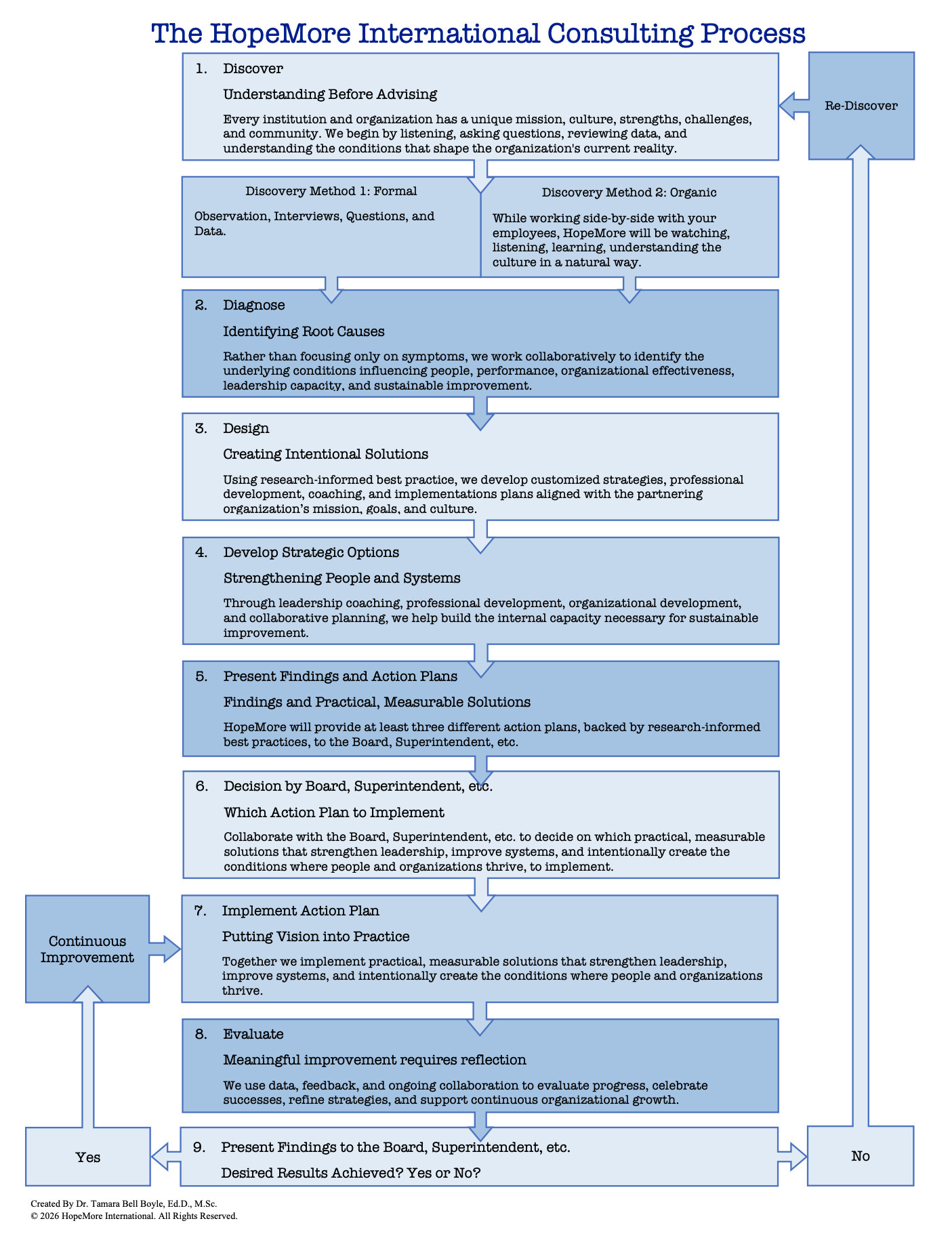
The HopeMore International Consulting Process
What conditions are affecting this person, and how can we intentionally create an environment where they can succeed?