
Hopemore International Educational Leadership’s Philosophy
Where Are They Now?
The effects of the COVID-19 pandemic did not end when students returned to school.
Each student experienced the pandemic differently based on family circumstances, instructional support, technology access, and learning opportunities.
As those students continue progressing through elementary school, secondary education, college, and the workforce, educational leaders have an opportunity—and a responsibility—to better understand these long-term effects.
HopeMore International encourages organizations to examine student success from a longitudinal perspective while focusing on understanding, support, and intentional institutional improvement rather than blame.
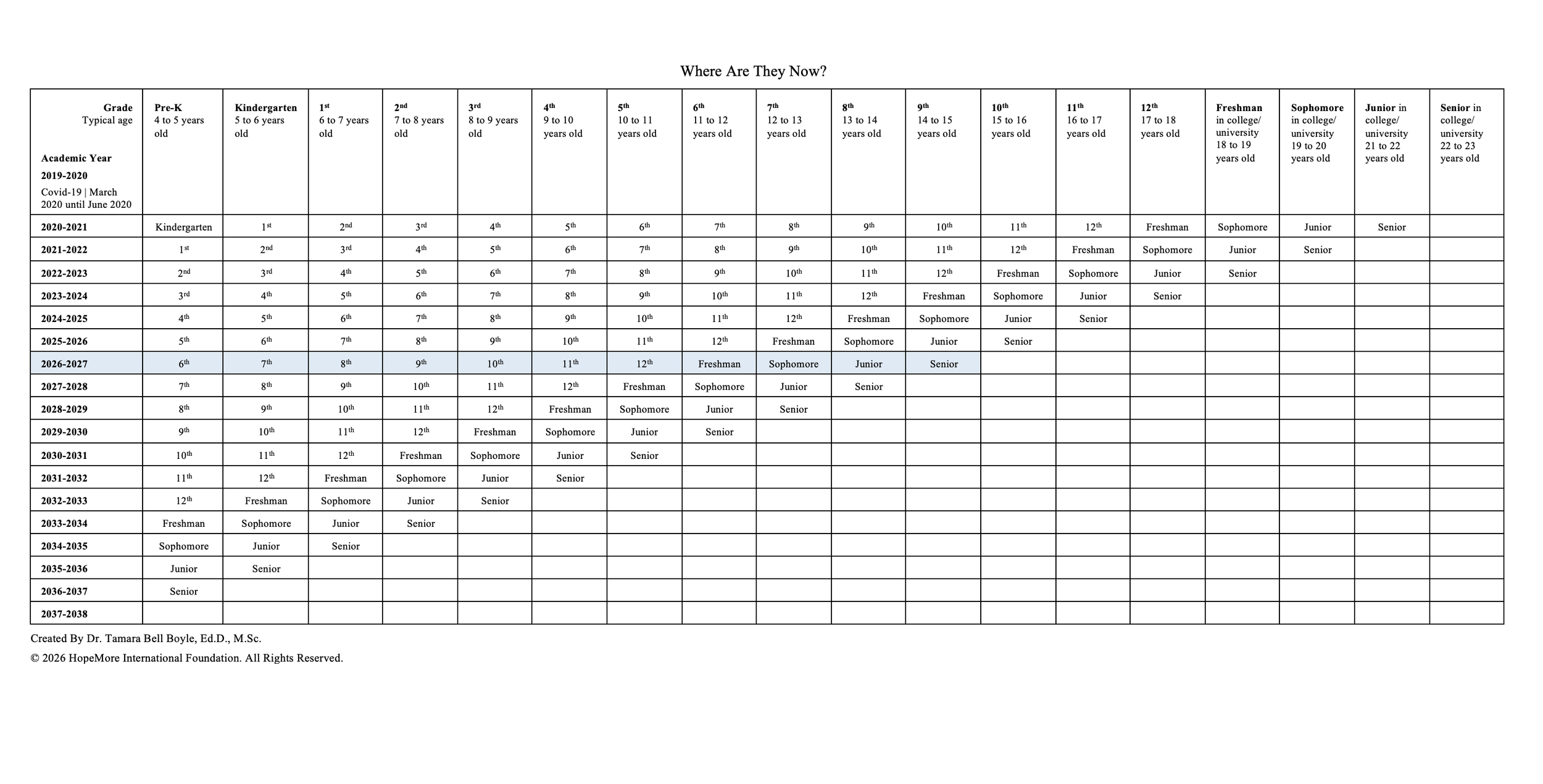
HopeMore International wholeheartedly believes all educators should consider what grade their students were in during the Covid-19 pandemic lock-down, because their student(s) could be missing information from that time period (i.e., Covid-19 learning gap).
The chart above illustrates where they (i.e., the students) are now and where the students were during the Covid-19 pandemic lock-down. Using the blue highlighted row, for the academic school year of 2026-2027, locate the student’s current grade. Then the top of that column will show what grade the student(s) was in during the Covid-19 pandemic lock-down (i.e., March 2020 until June 2020). In addition, one should also consider the academic school year of 2020-2021 because some schools allowed their students to attend school in-person one day a week and four days remote; then a few months later allowed their students to attend school in-person two days and three days remote. Furthermore, some parents chose to keep their children home and had them attend school remotely all five days. Lastly, some schools required students who were exposed or came into close contact with a person who tested positive for Covid-19 to remain at home and learn remote up to two weeks. Therefore, educators should also consider the next grade, which is directly to the right of what grade the student(s) were in during Covid-19.
For example, a current 11th grader was in 4th grade during the Covid-19 pandemic lock-down (i.e., March 2020 until June 2020) and then 5th grade for when most educational institutions started the year with one day a week in-person and 4 days of the week remote, followed by a two days of the week in-person and three days of the week remote (i.e., academic school year of 2020-2021).
According to the chart above, students who were in Pre-K, 4 to 5 years old, during the Covid-19 pandemic lock-down (i.e., March 2020 until June 2020), will be high school seniors in the academic school year of 2032-2033 and higher education seniors in the academic school year of 2036-2037.
However, adjustments are needed for those students that repeated a grade.
Please note, if you are viewing on your mobile device you may need to rotate your device to be in landscape mode for the full view of Where Are They Now? Chart.

Photo is Dr. Tamara Bell Boyle explaining the importance of understanding where students were during the COVID-19 Pandemic Quarantine, as part of her presentation of A Longitudinal Study: How Prepared Did Educators Feel They Were, to Teach Virtual—Prior, During, and After the COVID-19 Pandemic Quarantine?, at the 28th Annual International Conference on Education, on May 19, 2026, in Athens, Greece