
Hopemore International – Educational Professional Development (PD) Coaching | Purpose
The Professional Development (PD) Coaches program advances Hopemore International’s mission of creating a better tomorrow for future generations by equipping individuals and institutions with practical knowledge, leadership capacity, and evidence-based strategies that promote growth, excellence, and positive community impact.
Hopemore International – Educational PD Coaching | Vision
The program seeks to foster lifelong learning, ethical leadership, collaboration, and informed decision-making across educational institutions.
Hopemore International – PD Coaches
Hopemore International PD Coaches support individuals, educators, and institutions through research-informed coaching, development, strategic guidance, and professional growth initiatives. The program is designed to help participants strengthen skills, expand knowledge, improve performance, and achieve meaningful personal and educational institution outcomes.
Professional Development Coaches work collaboratively with students, parents, community stakeholders, and researchers, to guide teachers, administrators, and educational institution in identify goals, address challenges, and develop actionable strategies for growth and long-term success for students.
Core Areas of Support
Leadership and organizational development
Educational and academic coaching
Career and workforce readiness
Research and policy guidance
Communication and public speaking skills
Strategic planning and goal setting
Team development and collaboration
Professional ethics and integrity
Innovation, critical thinking, and problem-solving
Community engagement and impact initiatives
Coaching Methods
Professional Development Coaches may provide:
One-on-one coaching sessions
Group workshops and seminars
Virtual and in-person training programs
Mentorship and accountability support
Research-based learning resources
Conference presentations and educational forums
Customized development plans for individuals and organizations
Hopemore International Educational Leadership’s Philosophy
Where Are They Now?
Educators should consider what grade their students were in during the Covid-19 pandemic lock-down, because their student(s) could be missing information from that time period (i.e., Covid-19 learning gap).
The chart below illustrates students who progressed to the next grade each year. Using the blue highlighted row, for the academic school year of 2025-2026, locate the student’s current grade. Then the top of that column will show what grade the student(s) was in during the Covid-19 pandemic lock-down (i.e., March 2020 until June 2020). In addition, one should also consider the academic school year of 2020-2021 because some schools allowed their students to attend school in-person one day a week and four days remote; then a few months later allowed their students to attend school in-person two days and three days remote. Furthermore, some parents chose to keep their children home and had them attend school remotely all five days. Lastly, some schools required students who were exposed or came into close contact with a person who tested positive for Covid-19 to remain at home and learn remote up to two weeks. Therefore, educators should also consider the next grade, which is directly to the right of what grade the student(s) were in during Covid-19.
For example, a current 10th grader was in 4th grade during the Covid-19 pandemic lock-down (i.e., March 2020 until June 2020) and then 5th grade for the in-person and remote year (i.e., academic school year of 2020-2021).
According to the chart below, students who were in Pre-K, 4 to 5 years old, during the Covid-19 pandemic lock-down (i.e., March 2020 until June 2020), will be high school seniors in the academic school year of 2035-2036.
However, adjustments are needed for those students that repeated a grade.
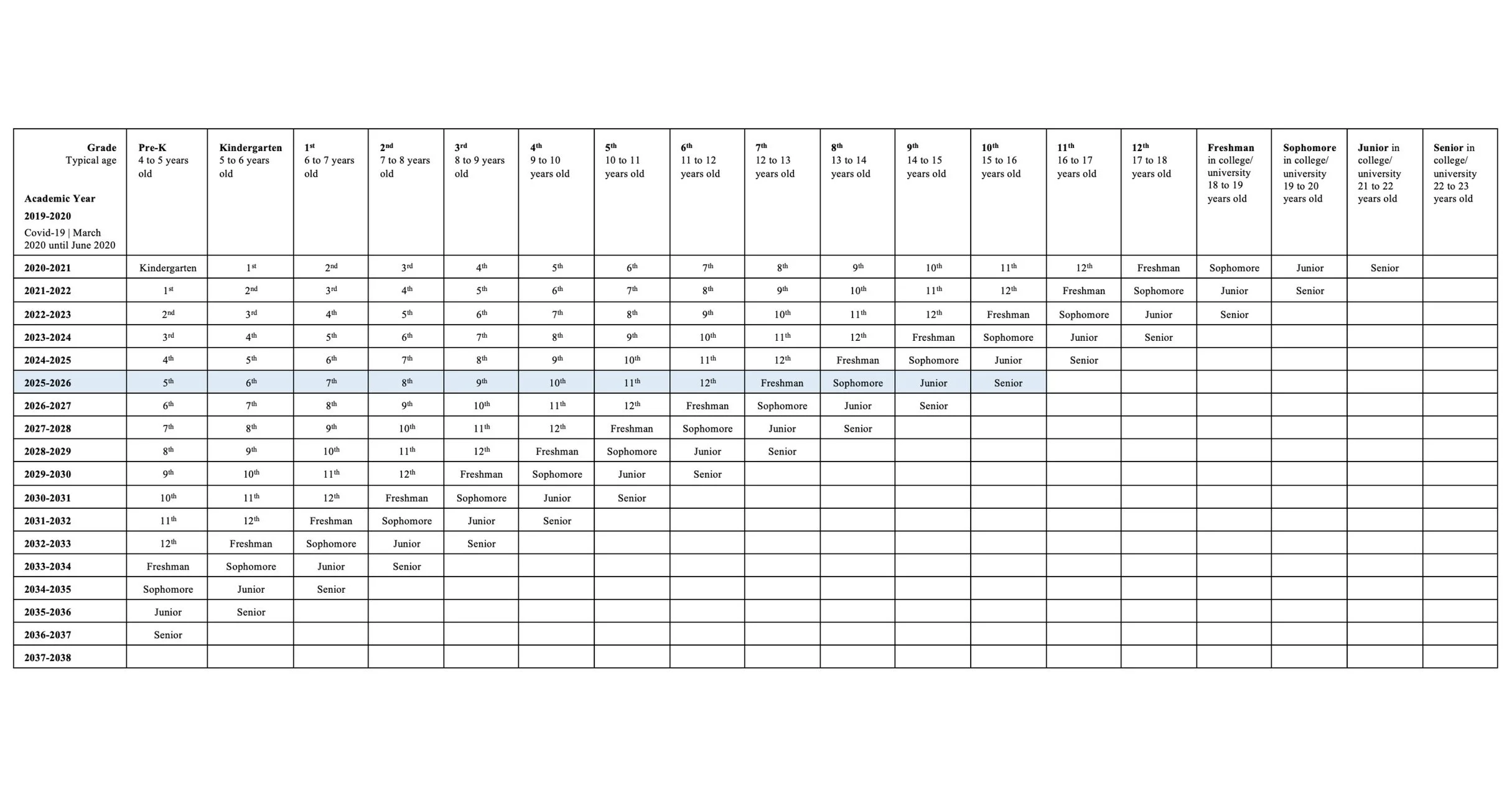
Created by Tamara Bell Boyle
Educational Professional Development (PD) Coaching Services
Hopemore International Educational PD Coaches provides the following discussions:
— An In-depth Review of Safety Procedures
— Putting Value On What You Learn - Ideas to transform student’s mindset
— Accountable: Who is accountable for a student’s education?
— The Big Divide Created by Covid
— The Debate: Teach to the Middle or Not?
— Could Educators be Teaching Students How to Plagiarize Without Even Realizing?
— Learned Skills: Are They Being Taught?
— Testing and Measuring: The Upside and Downsides
— What Substitutes Really Need
— How Good is Your Situation Awareness?
— Factors Related to Student Completion
Explore our wide range of services designed to help your educational institution move forward confidentially with confidence and precision.
Additional services are available as needed. Let us know your ideas.-
Prior Education Research
Boyle, T. B. (2021). Gwynedd Mercy University’s ABD Completion Program for Doctoral-non-completer-students Who Wish to Complete their Ed.D. Literacy Information and Computer Education Journal (LICEJ), Volume 12, Issue 1, ISSN: 2040 2589
Expanded version of Another Option for Doctoral-non-completer-students Who Wish to Complete their Ed.D. This expanded article includes the impact to society, institutions, the doctoral non-completer, and the economy, from a Low Student Completion Rate. In addition, a slightly deeper literature review. Lastly, there is a more detailed research findings and discussion section, in this expanded version.
Boyle, T. (2021). Another Option for Doctoral-non-completer-students Who Wish to Complete their Ed.D. World Congress on Education. Toronto.
Portions of doctorate dissertation research.
One of the major goals pursued by the author of this study is to give hope to doctoral-non-completer- students who wish to earn their Doctorate in Education (Ed.D.). The other major goal is to provide insight to instructors and institutions about why a doctoral student might leave a program whilst guiding the instructors and institutions about the factors doctoral-non-completer-students need to complete their Ed.D. degree. This research will examine the principal factors that influenced doctoral-non-completer-students to leave their original doctoral program without completing and the principal factors that influenced these prior doctoral-non-completer-students to complete their degree requirements in a different university’ s doctoral program. The research findings of this study identify employment and financial factors as the principal reasons for non-completion. The main reason Participant A completed the ABD program at Gwynedd Mercy University was on-line courses that was highly flexible. Whereas Participant B was able to restructure his life (i.e., retire) and Participant C was in a different financial situation.
Boyle, T. B. (2019, May). Three Case Studies of Factors Related to Non-completion of Doctorate Degree Then Doctoral Degree Attainment Through a Degree Completion Program at a Different Institution Retrieved from Proquest: https://www.proquest.com/openview/31f370ab567c08d5e9ecd515d008a226/1?pq-origsite=gscholar&cbl=18750&diss=y
This research compared the factors that influenced doctoral-non-completer-students to leave their original institution with the factors that influenced these prior doctoral-non-completer-students to complete their degree requirements in a different university’s doctoral program. The findings showed employment and financial factors as the principal reasons for non-completion of the doctorate. However, program environment, program disorganization, perception that not all of the required courses were in line with the degree, lack of support, lack of dissertation coursework, and job stressors were additional reasons for the students leaving. Whereas, highly flexible on-line courses, restructuring one’s life, and a different financial situation were the main factors of degree completion. However, a cohort model, connecting with other students, supportive dissertation chair, flexibility with program requirements, and course-structure.
Boyle, T.B. (2018, May 25) Factors Relating to Non-completion of Doctoral Degree in Education Mary Immaculate College International Conference. Limerick, Ireland.
This presentation was a summary of the research findings for Three Case Studies of Factors Related to Non-completion of Doctorate Degree Then Doctoral Degree Attainment Through a Degree Completion Program at a Different Institution.
Boyle, T.B. (2017) Fire Safety Procedures Action Plan Administration of Student Affairs Paper
This paper analyzes fire safety procedures in student affairs, focusing on academic and administrative policy, legal issues, and their intersections.