
Dr. Tamara Bell Boyle, Ed.D., M.Sc.
Founder, Consultant, and Researcher
Education
Ed.D., in Educational Leadership - Gwynedd Mercy University, Gwynedd Valley, PA, Awarded 2019
2 years of study for Ph.D. in Development Policy and Management, at University of Manchester, Manchester, England
M. Sc., in Human Resource Management (International Development) - University of Manchester, Manchester, England, Awarded 2013
B.S., Business (Accounting) - Stockton University, Galloway, NJ, Awarded 2011
A.A., Liberal Arts - Atlantic Cape Community College - Mays Landing, NJ, Awarded 2003
Experience
Since 2013, Adjunct Business Professor at Wilmington University taught Teach graduate and undergraduate courses including Human Resource Management, International Human Resource Management, Organizational Development, Change Management, and Legal Aspects of HRM
Since 2016, employed at several different school districts (PreK3 thru 12th) in Cape May County, NJ
Since 2018, committee member, on Remington College’s Distance Education Specialist Program Advisory, providing both an educator and student’s perspectives on their distance education curriculum.
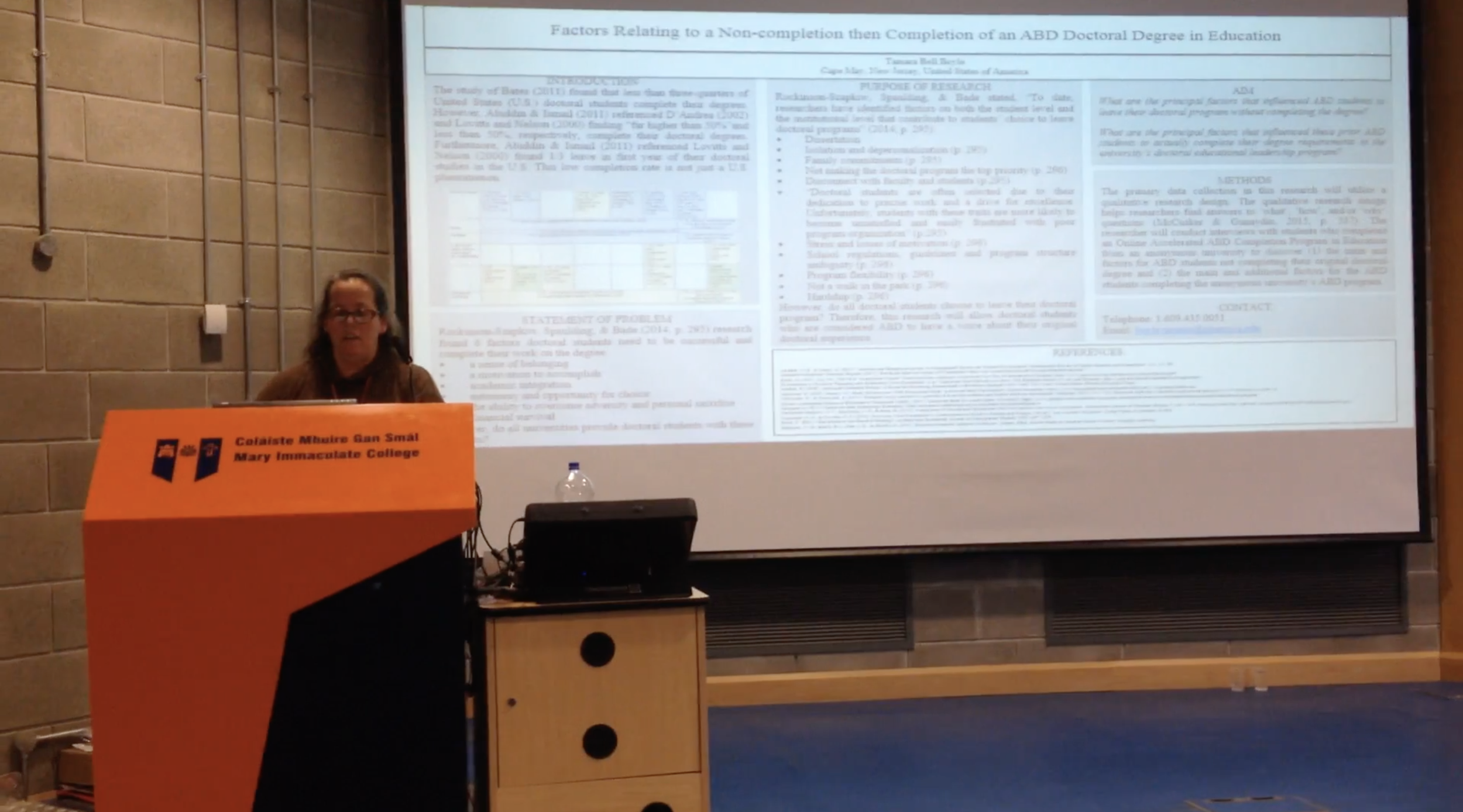
In image below is a conference poster for Factors Relating to a Non-completion then Completion of an ABD Doctoral Degree in Education that was presented at Mary Immaculate College International Conference in Limerick, Ireland.

Scholarly Activities and Annotated Bibliographies
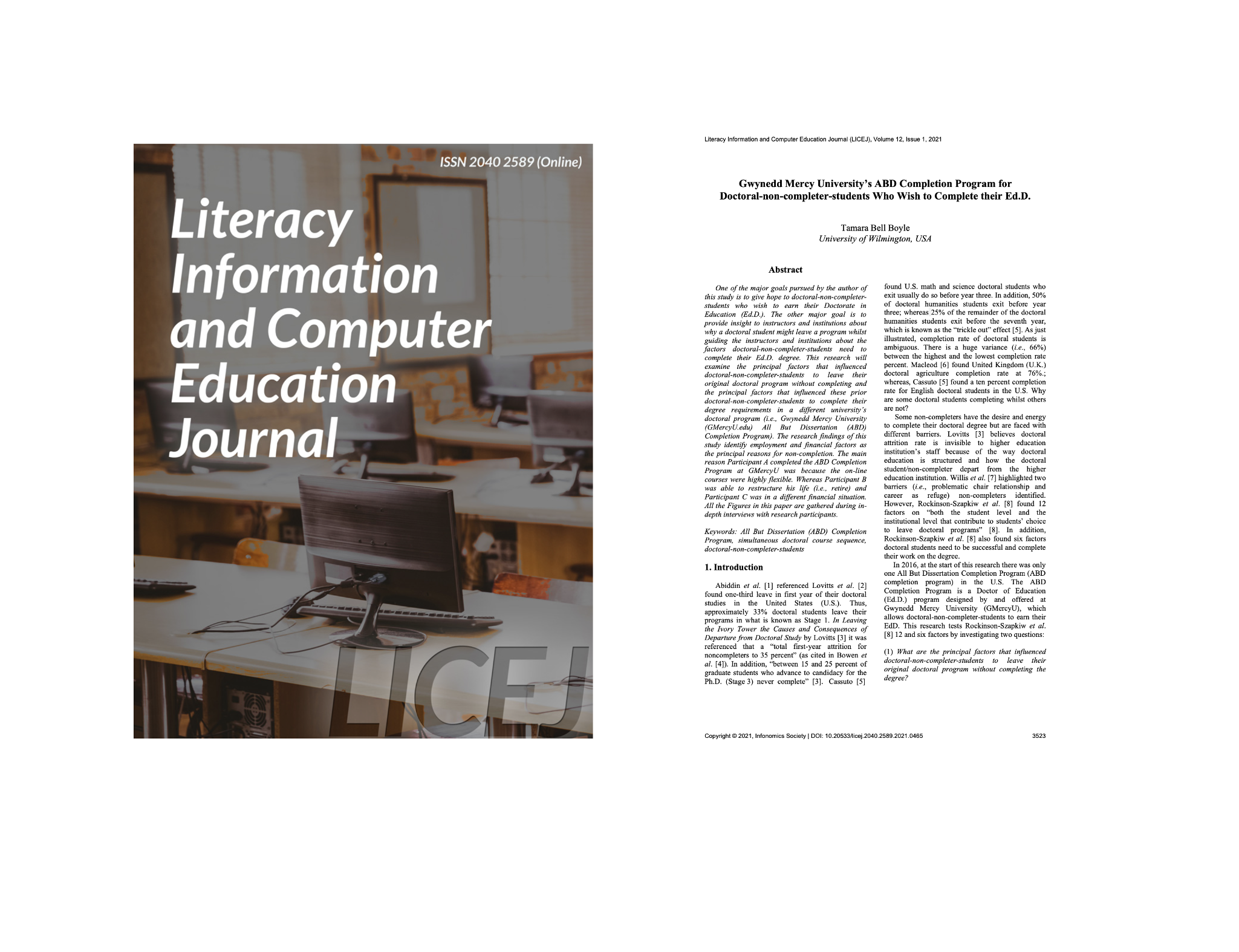
Boyle, T. B. (2021). Gwynedd Mercy University’s ABD Completion Program for Doctoral-non-completer-students Who Wish to Complete their Ed.D. Literacy Information and Computer Education Journal (LICEJ), Volume 12, Issue 1, ISSN: 2040 2589
Expanded version of Another Option for Doctoral-non-completer-students Who Wish to Complete their Ed.D. This expanded article includes the impact to society, institutions, the doctoral non-completer, and the economy, from a Low Student Completion Rate. In addition, a slightly deeper literature review. Lastly, there is a more detailed research findings and discussion section, in this expanded version.
Boyle, T. B. (2021, September 17). GMercyU Another Option for Doctoral noncompleter students Who Wish to Complete their Ed.D.. Retrieved from YouTube: https://www.youtube.com/watch?v=QoSWjNwTHF8&list=PLZvpa86yzz09PXM0JdgIm12RKFAH7V-PS&index=11
Edited Video from World Congress on Education.
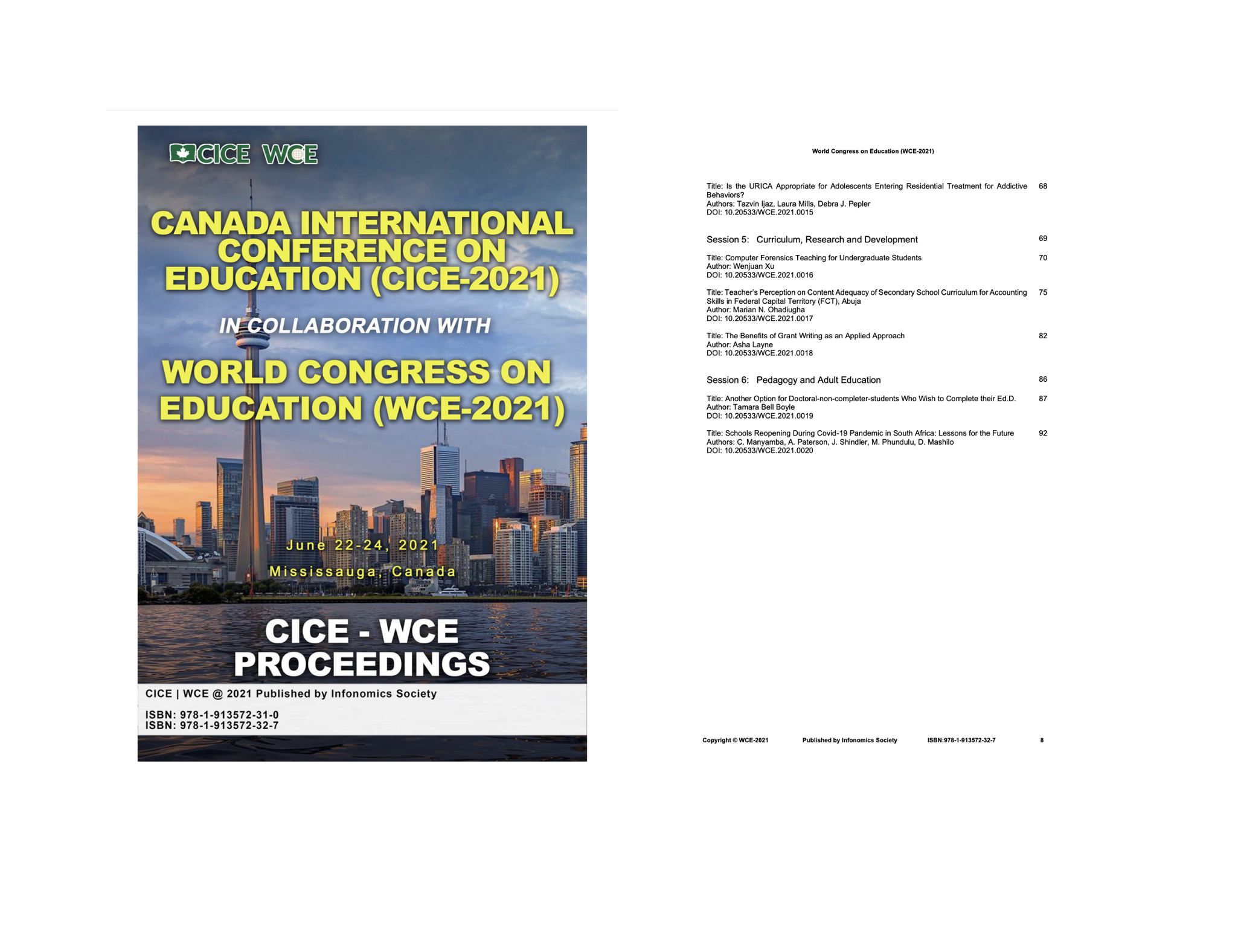
Boyle, T. (2021). Another Option for Doctoral-non-completer-students Who Wish to Complete their Ed.D. World Congress on Education. Toronto. Retrieved from https://www.linkedin.com/in/tamarabellboyle/overlay/Position/2138056126/treasury/?profileId=ACoAAAZxGAEBEWo7wmfWx7LPH_6NAVRQpT62j20
One of the major goals pursued by the author of this study is to give hope to doctoral-non-completer- students who wish to earn their Doctorate in Education (Ed.D.). The other major goal is to provide insight to instructors and institutions about why a doctoral student might leave a program whilst guiding the instructors and institutions about the factors doctoral-non-completer-students need to complete their Ed.D. degree. This research will examine the principal factors that influenced doctoral-non-completer-students to leave their original doctoral program without completing and the principal factors that influenced these prior doctoral-non-completer-students to complete their degree requirements in a different university’ s doctoral program. The research findings of this study identify employment and financial factors as the principal reasons for non-completion. The main reason Participant A completed the ABD program at Gwynedd Mercy University was on-line courses that was highly flexible. Whereas Participant B was able to restructure his life (i.e., retire) and Participant C was in a different financial situation.
Boyle, T. B. (2021, June 24). Another Option for Doctoral-non-completer-students Who Wish to Complete their Ed.D.. Retrieved from YouTube: https://www.youtube.com/watch?v=jKothiuyad4&list=PLZvpa86yzz09PXM0JdgIm12RKFAH7V-PS
Raw video footage of presentation from World Congress on Education
Boyle, T. B. (2019, May). Three Case Studies of Factors Related to Non-completion of Doctorate Degree Then Doctoral Degree Attainment Through a Degree Completion Program at a Different Institution. Retrieved from Proquest: https://www.proquest.com/openview/31f370ab567c08d5e9ecd515d008a226/1?pq-origsite=gscholar&cbl=18750&diss=y
This research compared the factors that influenced doctoral-non-completer- students to leave their original institution with the factors that influenced these prior doctoral-non-completer-students to complete their degree requirements in a different university’s doctoral program. The findings showed employment and financial factors as the principal reasons for non-completion of the doctorate. However, program environment, program disorganization, perception that not all of the required courses were in line with the degree, lack of support, lack of dissertation coursework, and job stressors were additional reasons for the students leaving. Whereas, highly flexible on-line courses, restructuring one’s life, and a different financial situation were the main factors of degree completion. However, a cohort model, connecting with other students, supportive dissertation chair, flexibility with program requirements, and course-structure when writing dissertation were additional factors for degree completion.
Boyle, T.B. and Villegas, K (2018, Nov 16) Leadership Style Theory. Retrieved from https://prezi.com/rljbxjgxdmws/leadership-style-theory/?present=1.
This presentation discusses the main components of Leadership Style Theory, Various Models within Leadership Style Theory, How Leadership Style Theory differs from Other Theories.
Boyle, T.B. (2018, May 25) Factors Relating to Non-completion of Doctoral Degree in Education. Mary Immaculate College International Conference. Limerick, Ireland. Retrieved from https://www.youtube.com/watch?v=fqUf6HHAPk8&list=PLZvpa86yzz09PXM0JdgIm12RKFAH7V-PS&index=2.
This presentation was a summary of the preliminary research findings for Three Case Studies of Factors Related to Non-completion of Doctorate Degree Then Doctoral Degree Attainment Through a Degree Completion Program at a Different Institution.
Boyle, T. B. (2017) Fire Safety Procedures Action Plan: Administration of Student Affairs Paper. Retrieved from https://www.linkedin.com/in/tamarabellboyle/details/experience/2138056126/multiple-media-viewer/?profileId=ACoAAAZxGAEBEWo7wmfWx7LPH_6NAVRQpT62j20&treasuryMediaId=1635554362601.
This paper analyze fire safety procedures in student affairs, focusing on academic and administrative policy, legal issues, and their intersections. It examines the law’s impact on campus safety, including students, faculty, staff, and emergency responders, and highlights concerns for public versus private institutions. The paper recommends best practices, consulting legal counsel, and steps universities should take to strengthen fire safety preparedness.
Boyle, T. B. (2017) Fire Safety Procedures Action Plan: Administration of Student Affairs presentation. Retrieved from https://prezi.com/view/uVg9eMWW68BCCxwZ5muQ/.
This presentation analyze fire safety procedures in student affairs, focusing on academic and administrative policy, legal issues, and their intersections. It examines the law’s impact on campus safety, including students, faculty, staff, and emergency responders, and highlights concerns for public versus private institutions. The presentation recommends best practices, consulting legal counsel, and steps universities should take to strengthen fire safety preparedness.
Boyle, T. B. (2015). Employee empowerment and the impact on job security and the psychological well-being of the employees. (Ph.D. thesis Chapters 1, 2, and 4). Retrieved from https://www.linkedin.com/in/tamarabellboyle/overlay/education/83118511/multiple-media-viewer/?treasuryMediaId=1565400796622.
This research will investigate the difference between continuous improvement empowerment and psychological empowerment whilst learning its implications on the employee’s job security and psychological well-being in the attempt to demonstrate if there is a variance between a technical and a non-technical job category. This research will explore the perception of the employees—technical and non-technical job categories—which are being empowered, in order to discover the similarities and the dissimilarities in the way the employee perceives, receives, and utilizes empowerment. There are two important elements of this research. One important element of this research is to discover if there is a job category variance from the way the employee perceives, receives, and utilizes empowerment. The other important element of this research is to discover what impact the variance has on the employee’s job security and/or the employee’s psychological well-being.
Boyle, T.B. (2012) An in Depth Look at New Jersey’s 2011 License Change: Effects on New Jersey’s Casino Dealers and New Jersey’s Casino Organizations. Retrieved from https://www.linkedin.com/in/tamarabellboyle/overlay/Education/83118511/treasury/?profileId=ACoAAAZxGAEBEWo7wmfWx7LPH_6NAVRQpT62j20.
This study examined the impact of New Jersey’s 2011 casino licensing changes on dealers and entry-level supervisors in Atlantic City. Findings indicate that replacing the 21–License with the weaker CER–35 registration card reduced employees’ sense of job security and motivation. The discontinuation of state-tracked work hours since 1995 further contributed to diminished stability. The research also revealed significant “reality gaps” between employees, management, the New Jersey Division of Gaming Enforcement, and casino HR departments, highlighting conflicting perspectives on accountability and oversight. Overall, the licensing change weakened employee security while creating organizational disconnects.
Boyle, T. B. (2012) Is the Gaming Industry in Macao, China Sustainable? Retrieved from https://www.linkedin.com/in/tamarabellboyle/overlay/education/83118511/multiple-media-viewer/?treasuryMediaId=1565400697665.
This research showed how quickly the gaming market has grown in Macao, China after going from a monopoly to an oligopoly market. In addition, the research showed how the Chinese Government played an important role in development. At the time of the writing the authors in the literature review, were predicting the future of Macao. With time and financial statements, the predictions were incorrect. The literature stated there was a doubt about the growth in Macao; however, the gaming market has grown in Macao, while under construction. Convention tourism is another market Macao could explore. Learning what Las Vegas and other destinations did correct and wrong will allow more knowledge and different approaches to be taken by the gaming industry. The Chinese Government manages the supply therefore the Chinese Government manages the gaming competition. When the Chinese Government issued the three concessions, they probably did not expect the reaction to be so over- whelming. Now the government needs to play catch-up with the infrastructure of Macao and Cotai, they have the monetary resources but could have trouble with the human resources. Hopefully the dealers and construction employees will not look at the short-term monetary reward they will receive but will take the opportunity to build themselves a career and/or further their education. Looking at the past financial figures in a five-year block shows that even with construction on going Macao was and should be sustainable. Macao’s infrastructure needs to be addressed and the competition in other Asia Markets needs to be constantly examined.
Boyle, T. B., Ford, A., and Kuzmich, A. (2010) Wynn, MHM Resort, and Las Vegas Sands. Retrieved from https://www.linkedin.com/in/tamarabellboyle/overlay/Education/65483984/treasury/?profileId=ACoAAAZxGAEBEWo7wmfWx7LPH_6NAVRQpT62j20.
This paper discusses Wynn Resorts, MGM Resort International and Las Vegas Sands. A company overview, comparing and contrasting; the Return on Asset (ROA), Return on Equity (ROE), Return on Investment (ROI), Revenue per Employee, Total Debt to Equity, Earning per Share (EPS) and Stock price. A SWOT Chart is providing the comparing and contrasting of the companies. Concluding with Future Scenarios for the companies. Allowing investor to make their best decision on which company to invest in.